 MikeROS™NewMikeROS v3 is live and ready for trial
Only hallucination-free Legal AI that reasons like a lawyer
Most lawyers settle for the best citation they can find, not the best one they should have. MikeROS changes that. It’s the only Legal AI that reasons like a lawyer: reasoning from the nature of your case to surface the authority you need, then building the reasoning chain step by step, with zero hallucination in the reasoning and every link locked to verified law.

Legal AI that invents citations is a malpractice risk
The hard part of legal AI isn’t writing fluent prose. It’s being right. Tools built on large language models are designed to predict the most likely next words, not to find the correct answer, so they will confidently cite cases that were never decided, misstate the holdings of the ones that were, and wrap it all in reasoning that reads as authoritative but cannot be checked. A 2025 Stanford and Yale study in the Journal of Empirical Legal Studies found hallucinated or erroneous output in 17–33% of answers from the leading commercial legal-AI tools. In litigation, a single fabricated citation can sink a filing, or a career. “Usually right” is not a standard the profession can work to.
You can’t fully trust the legal advice you get from your current AI.
Your team burns billable hours double-checking AI research it can’t verify.
On-point precedents get missed, because the AI can’t reason the way a lawyer does.
These aren’t workflow problems. They’re a fundamental limit of how general-purpose legal AI is built.
The difference is provability
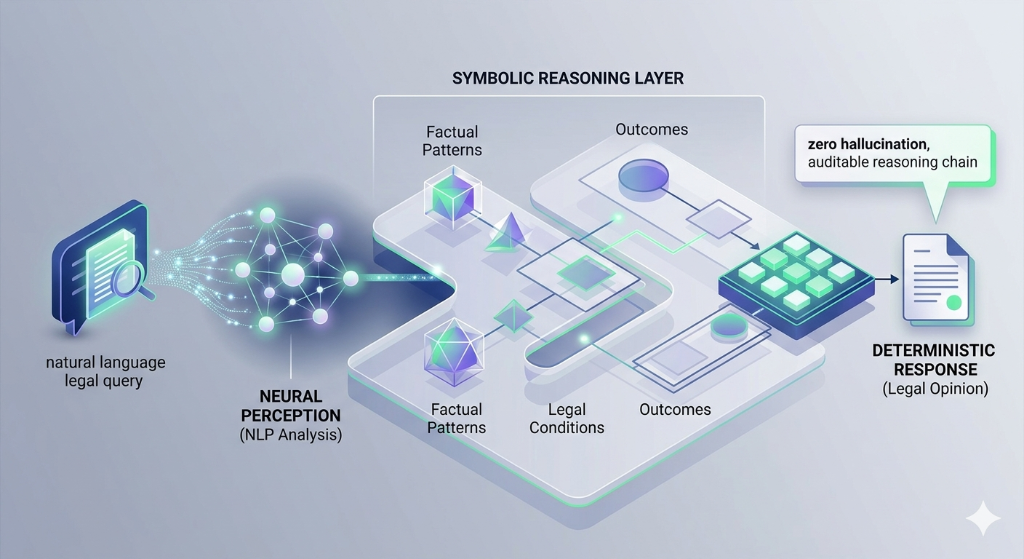
MikeROS keeps the fluency of an LLM for understanding the question, but moves every decision onto a deterministic reasoning engine that can show its work.
Generic legal AI
- LLM predicts the answer
- Citations may not exist
- No proof of correctness
- Hope it's right
MikeROS
- LLM understands the question
- Reasonex reasons deterministically
- Every citation verified against live databases
- Provably correct, with a full audit chain
Read. Reason. Prove.
Three layers, each doing only what it is good at, so the reasoning is necessary, not probable.
Read
Neural language understanding turns a plain-English legal question into structured legal intent. The LLM listens; it never decides the answer.
Reason
The Reasonex engine applies jurisdiction-specific rules through symbolic, deterministic inference, constructing a formal logical proof rather than a probable guess.
Prove
Every output ships with a complete audit chain: the answer, the citation, the paragraph, the applicable rule, and the full reasoning behind it.
Where litigators put it to work
Contract review
Clause-by-clause analysis with the reasoning shown for every flag.
Precedent research
Matches cases on how their facts fit together, not on shared keywords, so it surfaces genuinely on-point precedent.
Procedural computation
Deadlines and rules-of-court calculations derived directly from the governing rules.
Document drafting
Court document drafting with forms compliance built in.
Compliance verification
Regulatory checks traced end-to-end against the applicable framework.
Training & QA
Associate training and quality review with transparent, reviewable reasoning.
Why it holds up in practice
Verified citations only
Every citation is checked against live legal databases. If a source can’t be verified, it isn’t cited.
Jurisdiction-native rules
The rules engine reasons over the actual rules of court for each jurisdiction, not a generic approximation.
Full audit trail
Every answer carries its logical proof chain, so the reasoning can be checked, defended, and relied upon.
Data stays in-jurisdiction
Data residency is enforced by the architecture, not bolted on as a policy. Choose the on-premises option and your data never leaves your premises.
Deploy it the way that fits your firm
Standalone app
A web-based interface your team can use directly, with no integration required.
REST API
Programmatic integration with your practice-management and document systems.
Your AI workspace
Live in Claude Cowork, ChatGPT Work and Microsoft 365 Copilot Cowork: call MikeROS as a specialist legal tool without leaving your workflow.
MCP server
Deploy MikeROS as an MCP server for any other MCP-compatible assistant or agent platform.
On-premises
Run MikeROS fully on your own infrastructure, so your data never leaves your premises.
MikeROS v3 is live and ready for trial
Version 3 adds Practice Directions to the rules MikeROS reasons over, and it can now audit your submission in a single go. Call it directly from Claude Cowork, ChatGPT Work or Microsoft 365 Copilot Cowork: MikeROS connects as a specialist tool through the open Model Context Protocol (MCP), so every citation stays locked to a verified authority and every step of the reasoning stays traceable, without leaving your workflow.
Practice Directions
Now covered alongside the Rules of Court, so answers reflect how the court expects the rules to be applied.
Audit a submission in one go
Give MikeROS your submission and it audits it in a single pass, with every citation locked to a verified source.
In the AI you already use
Claude Cowork, ChatGPT Work or Microsoft 365 Copilot Cowork, connected over MCP.
FAQ
See MikeROS on your jurisdiction
Trial access · Proof-of-concept · Firm pilot